Concrete Pump Parts Knowledge
Hydraulic Oil in a Concrete Pump Water Box: Leak Source, Diagnosis, and Repair Scope
Hydraulic oil in a concrete pump water box can indicate leakage past a main drive-cylinder rod or gland seal, but the observation must be interpreted against the exact pump design. A visible stream or repeated oil film accompanied by falling reservoir level is more significant than a one-time trace. Some OEM designs allow small quantities of lubricant to reach the water box from another lubricated component, while other pumps use a lubrication-box fluid rather than plain water.
The first decision is therefore not “replace the delivery cylinder.” It is to establish what fluid belongs in that compartment, identify where the oil appears, and determine whether the hydraulic drive cylinder is leaking externally or the reservoir is being contaminated by water. Those are related possibilities, but they require different verification and repair work.
Which Cylinder Can Leak Oil into the Water Box?
Concrete-pump terminology causes expensive misunderstandings here. The delivery cylinder, also called the material or pumping cylinder, contains concrete and guides the delivery piston. The drive cylinder, often called the main hydraulic or differential cylinder, converts hydraulic pressure and flow into piston motion. A connecting rod or coupling transmits that motion through the water-box area.
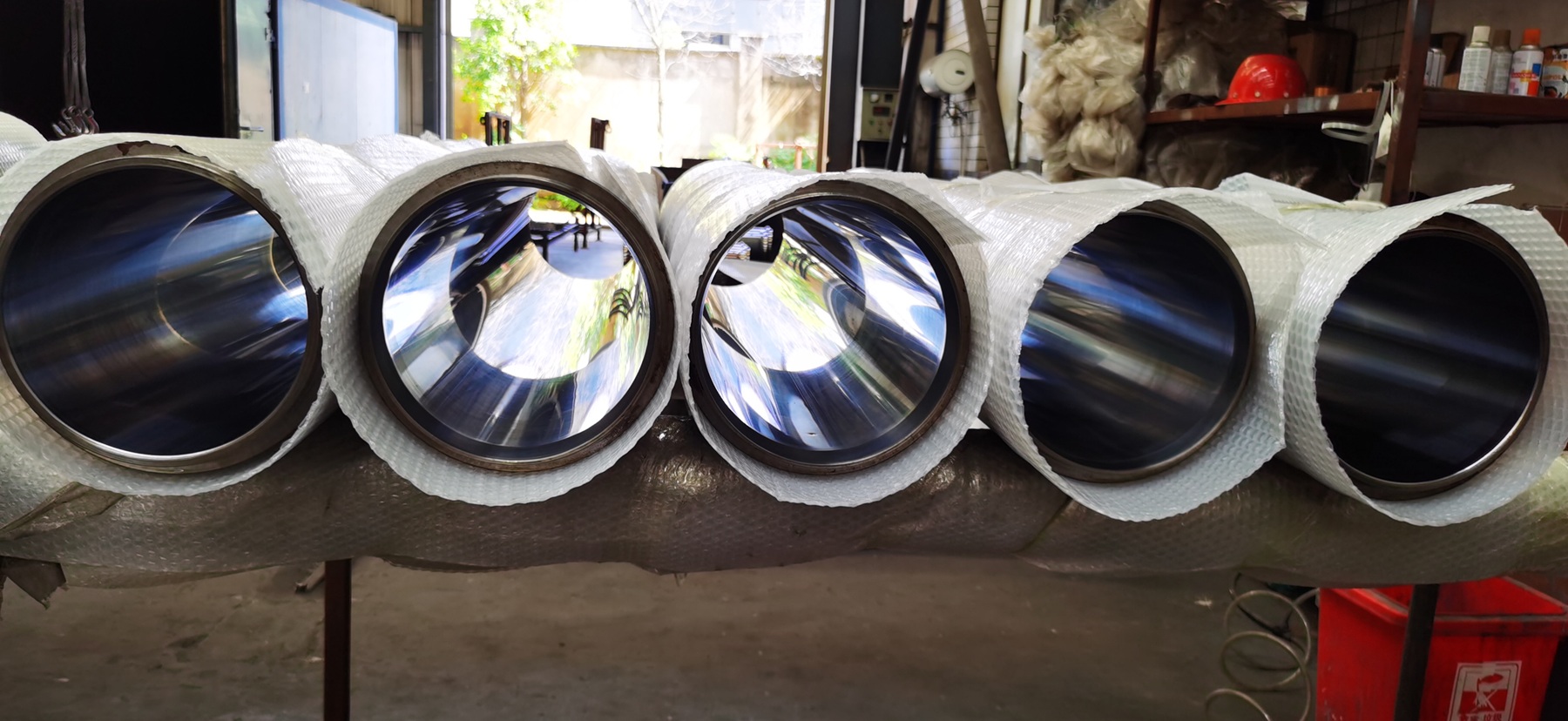
Because hydraulic oil is contained on the drive side, an oil path into the water box normally originates at the drive-cylinder rod-sealing area or another model-specific lubricated component. The Concrete Pump Delivery Cylinders should still be inspected if slurry, piston wear, scoring, or loss of concrete-side sealing is also present, but a chrome-plated material cylinder does not itself contain hydraulic oil.
This distinction also separates two seal failures that are often confused. Leakage across a drive-cylinder piston seal is internal bypass; it can disturb force, synchronization, or stroke without necessarily releasing oil into the water box. Leakage past a rod or gland seal crosses the external boundary around the moving rod and can become visible in the water box. Cylinder construction varies, so the parts drawing and hydraulic schematic for the exact machine remain controlling.
Does Any Oil Film Prove a Drive-Cylinder Seal Failure?
No. An oil film is an observation, not yet a root-cause diagnosis. The Putzmeister P 718 operating instructions state that small fluid quantities in its water box can come from the dry-running cut-out on the delivery pistons; the same manual treats clearly visible fluid escape as evidence that the drive cylinders are not properly sealed. Schwing operating guidance, by comparison, identifies oil streaks or a milky emulsion in the water box as a possible sign of worn differential-cylinder sealing.
Another complication is compartment design. Some Mayco machines describe a cylinder lubrication box and specify an oil-based fluid for that box. On such a machine, the mere presence of oil is not abnormal. Filling a compartment with plain water, soluble oil, motor oil, or another fluid based on a different brand’s manual can produce a false diagnosis and may harm the machine.
Before evaluating color or sheen, answer three questions from the correct OEM documentation:
- Is the compartment a water box, flush box, or lubrication box?
- What fluid and level does the manufacturer specify during operation?
- Does the design intentionally lubricate a delivery-piston component near the box?
Only after that baseline is known can a technician decide whether a trace is expected, whether contamination is left from recent service, or whether fresh hydraulic oil is crossing a failed sealing boundary.
What Observations Make a Hydraulic Leak More Likely?
A drive-cylinder external leak becomes more credible when several independent observations agree. Fresh oil that repeatedly forms at one rod as it moves, a measurable fall in the hydraulic reservoir, and a clean box that quickly develops new oil are more diagnostic than a photograph of dirty standing water after washout.
| Observation | Possible explanation | Useful verification | Conclusion to avoid |
|---|---|---|---|
| Thin film appears once after delivery-piston service | Residual or intentionally applied lubricant | Confirm the OEM lubricant path; clean and observe whether it returns | “The main cylinder needs replacement” |
| Fresh oil beads or runs from one drive-cylinder rod area | Rod/gland seal leakage or damaged rod counterface | Identify the side and point of origin while following guarded OEM observation procedures | “Both cylinders need seal kits” |
| Oil streaks increase while hydraulic reservoir level falls | Active hydraulic-fluid loss into the box | Record box condition and reservoir level at consistent machine states; inspect external leak paths | “Top up the reservoir and keep pumping” |
| Milky fluid is present only in the box | Oil dispersed in water, intentional soluble fluid, or washout residue | Confirm specified box fluid and collect a clean sample if needed | “Milky appearance identifies the exact failed seal” |
| Hydraulic reservoir oil is milky or water content rises | Water ingress through a seal or another external source | Use correct sampling practice and laboratory analysis; inspect all credible ingress paths | “The water box is the only possible source” |
| Stroke deteriorates but no external oil is visible | Internal cylinder bypass, check-valve leakage, control timing, or another hydraulic fault | Apply the OEM short-stroke and leakage tests | “No visible leak means every drive-cylinder seal is sound” |
Direction and timing matter. If oil appears around only one rod, record that side rather than mixing the evidence during cleaning. If the amount changes as the oil warms, record temperature and operating condition without treating temperature response as proof; lower viscosity may make an existing clearance leak more visible, but it does not identify the damaged part by itself.
A Safe Diagnostic Sequence
Never reach into an open water box while the pumping system can move. The coupling, piston rods, and pistons create crushing and shearing hazards. Concrete pumps may also retain hydraulic accumulator pressure and trapped material pressure after the engine stops. Guards, covers, lockout steps, pressure-release procedures, and permitted test modes differ by model.
- Confirm the correct fluid specification. Use the machine’s model and serial number to find the applicable operating manual. Record what the box was filled with and whether lubricant was recently added during piston service.
- Establish a clean baseline. With the machine isolated as required, drain or clean the compartment according to the OEM method. Inspect the removed fluid rather than immediately discarding the evidence.
- Check external sources first. Inspect hoses, fittings, grease points, recently serviced components, and spill paths above the box. Hydraulic oil added carelessly near an open cover can imitate a cylinder leak.
- Observe from an approved position. With covers and guards configured as the manufacturer requires, determine whether fresh oil originates at one rod/gland area and whether it appears during extension, retraction, or both. Use remote observation or a camera only where permitted; do not defeat an interlock.
- Correlate the reservoir. Compare hydraulic-oil level at the same temperature and cylinder position. A sight-glass change caused by different machine position should not be misread as fluid loss.
- Separate external leakage from internal bypass. If the complaint also includes short stroke, drift, or weak motion, use the OEM’s hydraulic test plan. Do not loosen a pressurized hose to improvise a leakage test.
- Check for reverse contamination. If reservoir oil is cloudy or laboratory water content is increasing, investigate the water-box boundary together with breathers, washing practices, coolers, fill containers, and condensation.
A clean-and-observe cycle is not permission to continue normal production with a known leak. It is a controlled diagnostic step. If fresh hydraulic oil is visibly escaping, stop routine pumping and follow the OEM service decision before reservoir loss, water ingress, or lubricant starvation expands the repair scope.
Why Water in the Hydraulic Reservoir Changes the Urgency
Oil moving outward and water moving inward can use the same damaged sealing region under different pressure conditions, but a milky water box does not prove that the reservoir is contaminated. Inspect the reservoir separately and sample it correctly.
Donaldson’s hydraulic-fluid guidance notes that water can reduce lubricity, encourage sludge, and contribute to corrosion and surface degradation. Visual cloudiness is useful as a warning, but it is not a quantitative water measurement. ASTM D6304 describes coulometric Karl Fischer methods for determining water in lubricating oils and other petroleum products. The test result should be compared with the fluid supplier’s and machine manufacturer’s limits; ASTM D6304 supplies a measurement method, not a universal concrete-pump discard limit.
Sampling quality matters. A wet bottle, a sample taken from settled reservoir-bottom water, or a sample collected immediately after adding fluid can produce a result that does not represent the circulating system. Record the sampling point, oil temperature, operating state, fluid identity, and recent top-ups. If water contamination is confirmed, the OEM should define whether filtration, dehydration, flushing, filter replacement, or complete fluid replacement is required after the leak is repaired.
When Is a Seal Kit Enough?
A seal kit is appropriate only when the cylinder’s reusable hardware remains within the applicable inspection limits. Installing new seals over a pitted, scored, corroded, bent, or dimensionally worn rod can damage the new sealing lip and reproduce the leak. The gland, bearing or guide surfaces, seal grooves, barrel bore, piston, ports, and fasteners also require inspection.
Repair scope normally falls into one of four categories:
- Correct an external source: remove spilled lubricant or repair a hose/fitting when the drive cylinder is not the source.
- Reseal the drive cylinder: use the exact seal arrangement when the rod, gland, barrel, and other reusable surfaces pass inspection.
- Restore or replace damaged hard parts: address rod coating damage, gland wear, or barrel damage through a qualified cylinder-repair process supported by specifications.
- Replace the complete cylinder: choose this when critical dimensions, hard-part condition, traceability, repair capability, or verification requirements make a reseal unreliable.
Do not select seals by nominal rod and bore diameter alone. Two kits can share headline dimensions yet differ in profile, material, hardness, energizer, pressure direction, backup-ring arrangement, groove fit, or compatibility with the hydraulic fluid and temperature range.
What Should Be Recorded Before Ordering Parts?
A useful parts request connects the symptom to an identifiable assembly. Record:
- pump manufacturer, exact model, serial number, year, and pump-kit version;
- the OEM name for the compartment and its specified operating fluid;
- left/right cylinder location and whether the leak occurs during extension or retraction;
- main drive-cylinder part number and seal-kit number, if legible;
- rod, bore, stroke, closed length, mounting, port, and rod-end/coupling details taken without rounding;
- photographs of the identification plate, gland, rod surface, ports, mounts, and connecting hardware;
- hydraulic-fluid type and the results of any OEM-approved leakage or oil-analysis test;
- whether reservoir level fell, reservoir oil became cloudy, or stroke behavior changed;
- condition of the delivery piston and material-cylinder bore if concrete-side contamination is also present.
The last point prevents two unrelated wear mechanisms from being collapsed into one diagnosis. Concrete slurry entering the water box points toward the delivery-piston/material-cylinder interface; hydraulic oil originating at the rod gland points toward the drive-cylinder boundary. Both can occur at the same time, and each should be documented on its own side of the water box.
Practical Follow-Up Questions
Can a small amount of oil in the water box be normal?
It can be on some designs. Putzmeister documents a small lubricant contribution from a dry-running protection component on the P 718, and some other machines specify an oil-based lubrication-box fluid. “Normal” must come from the manual for the exact model, not from a rule applied to every concrete pump.
Does hydraulic oil in the water box mean the delivery cylinder is worn?
No. The delivery cylinder contains concrete, not hydraulic oil. Oil traced to the drive-cylinder rod area points first toward the hydraulic cylinder’s external sealing boundary. Inspect the delivery cylinder separately when there is concrete slurry, rapid piston wear, scoring, or poor concrete-side sealing.
Can a leaking drive-cylinder piston seal put oil in the water box?
Not necessarily. A piston-seal leak is normally internal bypass between hydraulic chambers. Oil visibly escaping around the rod is more consistent with a rod/gland sealing problem. One cylinder may have both defects, but each requires its own evidence.
Is milky hydraulic oil enough to order a cylinder seal kit?
No. Milky reservoir oil indicates possible water contamination, but water can enter through several routes. Confirm water content, inspect the cylinder boundary and other ingress points, then match any seal kit to the exact cylinder. Repairing an assumed seal while leaving the real ingress source open wastes both fluid and parts.
Conclusion
Hydraulic oil in a concrete pump water box is best treated as a traceable leak-path problem. First establish what fluid belongs in the compartment. Then distinguish a one-time lubricant trace from active oil escape, identify the side and source, correlate it with reservoir behavior, and check separately for water in the hydraulic system.
That sequence keeps the repair decision technically honest. A clean delivery-cylinder bore does not clear a leaking drive-cylinder gland, an internal bypass fault may exist without visible oil, and a new seal kit cannot survive an unacceptable rod surface. The correct response comes from model-specific documentation, controlled observation, dimensional inspection, and a parts request that identifies the actual cylinder rather than the symptom alone.