Quick Summary
Concrete pump rock valves are supplied by Changsha Younglee Machinery for hopper transfer systems used in concrete pump replacement and repair programs. This page explains rock valve function, wear zones, outlet and mounting confirmation, material and machining considerations, and inquiry information. Buyers should send pump model, old valve photos, outlet size, mounting dimensions, quantity, and destination country.
Product overview
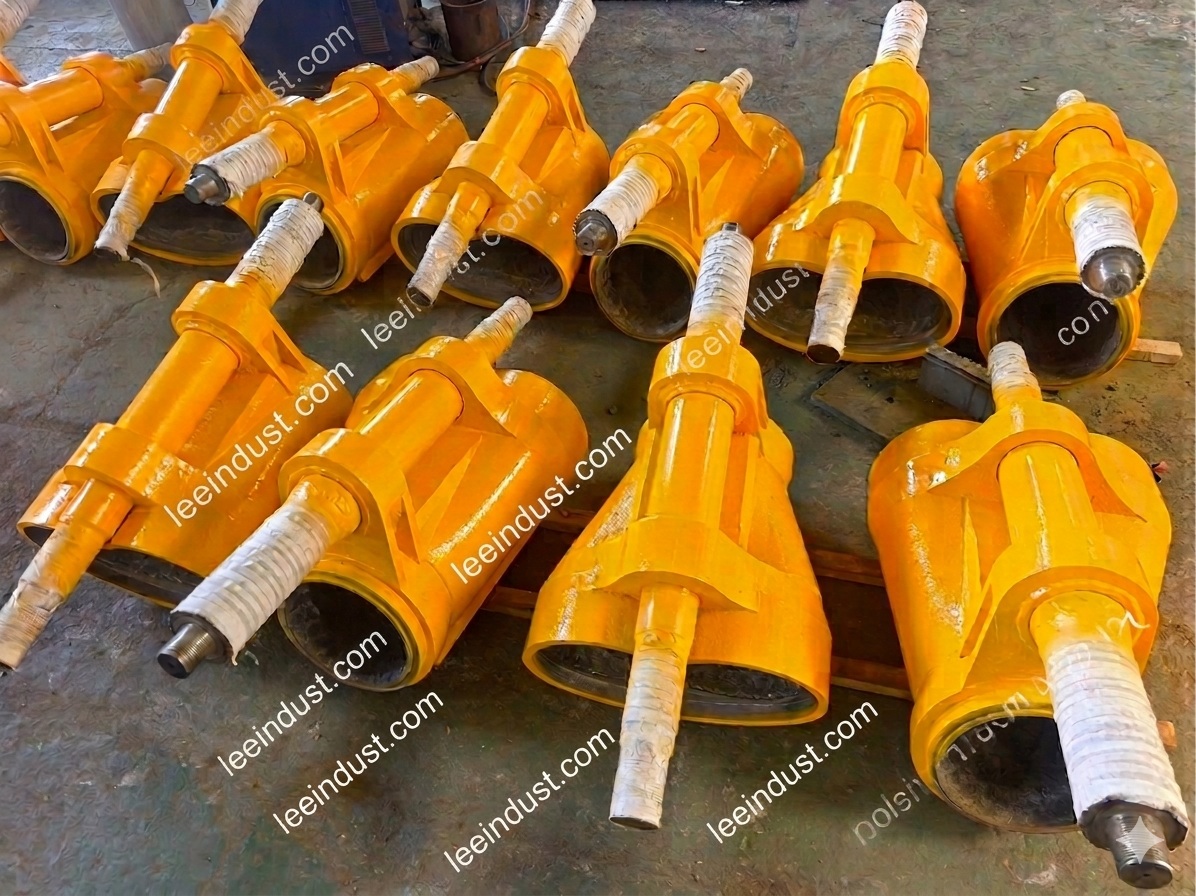
A concrete pump rock valve is a transfer valve used to control the movement of concrete from the pumping cylinders into the delivery line. It is found in certain concrete pump designs and serves the same general purpose as other valve systems: connecting the active pumping cylinder to the outlet while allowing the opposite cylinder to draw material from the hopper. The valve must work under concrete pressure, abrasive flow, and repeated mechanical movement. Because the part is located in the hopper and transfer area, it has a direct effect on pumping efficiency and maintenance cost.
Changsha Younglee Machinery supplies rock valve replacement parts for concrete pump repair and distributor supply. The rock valve is a technical component that should be selected according to pump model, valve shape, outlet connection, mounting dimensions, and related wear parts. Buyers often contact suppliers when the old valve is worn, damaged, difficult to seal, or no longer available from the original source. Our role is to help the buyer identify the correct replacement route and supply parts suitable for practical field use.
Role in concrete transfer
The transfer valve in a concrete pump must switch concrete flow between two delivery cylinders. In a rock valve system, the valve body moves to connect the pumping cylinder to the outlet and then changes position for the next stroke. This switching action must remain synchronized with the hydraulic cylinders and pumping pistons. If the valve timing, movement, or sealing condition is poor, concrete can leak backward, pressure can drop, and pumping output can become unstable.
The internal path of the valve must allow concrete to move with as little unnecessary resistance as possible. Concrete is not a simple liquid; it contains cement paste, sand, stone, water, admixture, and air. The valve must therefore tolerate abrasive particles and avoid shapes that encourage blockage. The working surfaces also need enough strength and wear resistance because aggregate impact can gradually change the valve profile.
Design and manufacturing considerations
Rock valve designs vary by pump type. Some are compact and shaped for specific hopper layouts, while others have larger valve bodies and heavier outlet structures. Important design points include the material passage, sealing contact, pivot or movement area, outlet connection, and interface with adjacent wear parts. A replacement valve should match the old part closely, especially where it contacts the pump body and related sealing components.
Manufacturing quality depends on material, forming or fabrication accuracy, machining, welding, finishing, and inspection. A rock valve may experience heavy local wear, so the critical areas should be processed with attention to durability. Welding must be strong and clean. Machined interfaces must remain accurate. The final product should be inspected for visible defects, dimensional consistency, and surface condition before packing. For export supply, the product should be protected against impact and corrosion during transportation.
When a rock valve should be replaced
A rock valve may need replacement when the concrete pump loses pressure, shows serious leakage, has abnormal switching noise, or consumes related wear parts too quickly. Visible wear, cracks, deformation, or damaged sealing areas are direct signs that the valve should be repaired or replaced. In some cases, an operator may continue using a worn valve for a short time, but the cost can increase because the pump must work harder and other parts may be damaged.
The replacement decision should be made together with inspection of the wear plate, cutting ring, outlet, seals, bearings, and hydraulic swing components. Installing a new rock valve while leaving badly worn related parts in place can reduce the benefit of the repair. Distributors can help customers by offering a complete inspection checklist and suggesting related parts when needed. This improves the chance that the repair will solve the actual problem rather than only replacing one visible component.
Technical information for buyers
To quote a rock valve accurately, the supplier needs more than the product name. The buyer should provide pump brand, pump model, valve photos, outlet size, mounting details, reference number, and quantity. If the old part has been removed, photos from multiple angles are useful. Measurements of key interfaces should be checked carefully. If there is uncertainty, a sample or drawing can be used for confirmation.
For distributors, it is important to classify rock valves by application and maintain clear product records. Some customers may describe the part differently depending on local language or maintenance habits. Terms such as transfer valve, rock valve, valve body, hopper valve, or pump valve may be used in inquiries. A good supplier response should clarify the exact product before quotation. This prevents wrong shipments and protects customer trust.
Material and wear resistance
Concrete pump valve parts are exposed to abrasive materials every time the pump operates. Wear resistance therefore matters, but it must be balanced with toughness and dimensional reliability. A very hard surface that cracks easily is not suitable. A soft part that wears quickly is also not acceptable. The correct approach depends on the pump design, concrete conditions, and the specific area of the valve. Critical surfaces may need wear-resistant processing, while the body must remain strong enough for repeated load.
Changsha Younglee Machinery can discuss the application with buyers and support practical supply for replacement use. If a customer has special concrete conditions, such as high aggregate abrasion or frequent high-pressure pumping, that information should be shared during inquiry. It may affect product selection, expected service life, and related parts recommendation.
Export and distributor support
Rock valves are heavy and application-specific parts, so export packing and identification are important. The product should be packed to prevent damage to working faces, outlet connections, and mounting areas. For distributor orders, labels and part identification help warehouse staff and customers avoid confusion. If multiple valve types are shipped together, packing lists should clearly separate each model and quantity.
A distributor selling concrete pump parts often needs a supplier who can support technical communication, not only a price list. Customers may send old part photos, unclear model names, or urgent repair requests. A factory-source partner can help review the information and recommend the next confirmation step. This service is especially useful when the distributor is building a product line in a market where many pump brands and models are operating at the same time.
Why Changsha Younglee Machinery
Changsha Younglee Machinery combines factory manufacturing experience with a product focus on concrete pump parts and accessories. The factory has served the concrete pump maintenance market for many years and is now building direct overseas communication through the English website. For rock valves, S-valves, delivery cylinders, and hydraulic cylinders, our aim is to provide realistic technical content and responsive inquiry support.
Buyers can use this page to understand the product and then send part details for quotation. We do not treat a rock valve as a generic casting or pipe. It is a working component in a concrete pump transfer system, and it should be selected carefully. With clear information from the buyer, our team can review compatibility, discuss quantity and packing, and prepare a quotation for distributor or service company purchasing.
Inquiry recommendation
To request a quotation for a concrete pump rock valve, please send the pump model, old valve photos, outlet size, quantity, destination country, and any reference number. If possible, include photos of related wear parts and the hopper area. This helps our team understand the complete replacement requirement and respond with more accurate product information.
Service market considerations
Rock valve demand can be more regional than common pipeline accessories because it depends on the pump designs operating in the local market. A distributor should first review which pump models are active among rental companies, concrete contractors, and repair workshops. If rock valve pumps are common, keeping the correct valve and related wear parts in stock can become a strong service advantage. If they are less common, a confirmed made-to-order route may be more practical than keeping many heavy valves in inventory.
For repair companies, the rock valve should be treated as part of the full transfer system. Before ordering, the technician should inspect whether the existing problem comes from the valve body, wear plate, seal, bearing area, or hydraulic movement. Accurate diagnosis prevents unnecessary replacement and helps the customer trust the repair advice. For export purchasing, the buyer should also consider shipping weight, packing volume, and the urgency of the repair. Planning these points before the pump stops working is usually much cheaper than arranging emergency freight after a job-site failure.
Related product and inquiry links
For broader replacement programs, buyers can also review concrete pump replacement parts, quality control for concrete pump replacement parts, request a quotation for concrete pump parts, concrete pump delivery cylinders, concrete pump s-valve assembly, concrete pump slewing cylinders.