Concrete Pump Parts Knowledge
Can You Turn a Concrete Pump Delivery Cylinder 180°? Wear Mapping and Limits
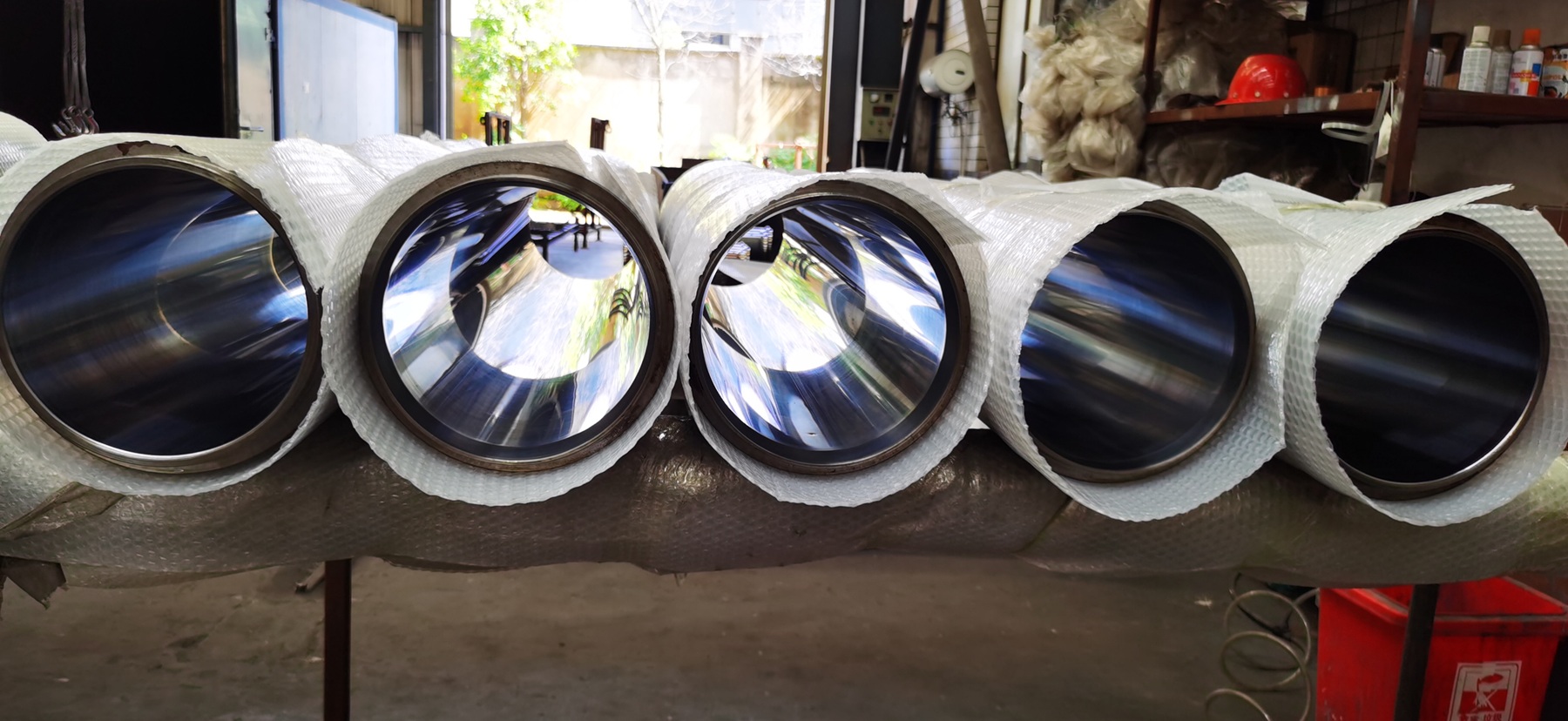
Some concrete pump delivery cylinders can be turned 180 degrees and returned to service, but only when the pump manufacturer permits it and inspection shows that the new running zone remains usable. Turning changes which part of the bore carries the most severe loading; it does not restore lost diameter, repair damaged chrome, remove taper, or correct misalignment. A cylinder that is uniformly enlarged, deeply scored, flaking, cracked, or already beyond its model-specific wear limit should not be treated as a rotation candidate.
The decision therefore begins with machine identification and a bore map, not with a calendar interval or a mechanic’s visual impression. The exact orientation, allowable wear, fasteners, seals, alignment method, and recommissioning procedure must come from the service information for that pump.
What Does Turning a Concrete Pump Cylinder Mean?
In this context, the component is the concrete-side delivery cylinder, also called a material, conveying, or pumping cylinder. It is not the hydraulic drive cylinder and it is not a delivery-line pipe. The delivery piston travels inside this bore while one side of the twin-cylinder pump draws concrete from the hopper and the other discharges through the transfer valve.
OEM literature sometimes describes removing the cylinder and changing its orientation so a less-worn portion of the circumference becomes the principal loaded area. A REED-hosted Waitzinger operation manual, for example, contains a model procedure for replacement or turning of conveying cylinders and states that they can be turned 180 degrees if this is done before wear becomes excessive. Putzmeister’s current iLS core-pump literature also describes a concrete cylinder that can be turned and reused because end-position forces produce increased wear.
Those examples establish that cylinder turning is a real maintenance option on certain machines. They do not establish a universal procedure. “Turn 180 degrees” must be interpreted through the drawing or manual for the exact assembly. Do not assume that a cylinder should be reversed end-for-end, rotated about its long axis, swapped from left to right, or reinstalled with ports and markings in a different position merely because another pump uses that arrangement.
Why Can a 180-Degree Turn Extend Service Life?
Turning can help when wear is circumferentially uneven and the opposite sector still has acceptable geometry and surface condition. The piston does not necessarily load every point around a working bore equally. End-position forces, piston guidance, assembly alignment, gravity, residue, and the local flow of abrasive paste can produce a stronger polished or worn track in one orientation. Repositioning a serviceable cylinder can move the existing wear track away from the most heavily loaded direction.
The effect is redistribution, not renewal. Imagine that a bore map shows greater diameter growth at the installed 6 o’clock direction than at 12 o’clock, while both axial ends and the remaining surface still satisfy the applicable limit. A permitted 180-degree rotation can move the less-worn sector into the former high-load orientation. The piston then runs against a different circumferential condition.
By contrast, rotating a cylinder does little when the diameter has increased by a similar amount around the entire circumference. It also does not move an axially worn zone to another part of the piston stroke. If the principal defect is bell-mouth wear, taper, or end-zone damage, a circumferential turn leaves that axial position where it was. This distinction is often missing from short maintenance advice.
Map the Bore Before Deciding
A single diameter measurement cannot show whether turning has a useful purpose. Record the installed top, bottom, left, and right references before removal, then measure at defined axial stations across the piston travel. At each station, readings in at least two identified directions help reveal ovality; more orientations may be appropriate when the wear pattern is irregular.
Use the instrument, master, temperature control, and measurement technique required by the workshop’s quality system. A two-point bore gauge can be useful for mapping shape because it can compare directions at the same depth. Record actual values and signed deviations rather than writing only “good” or “worn.” The existing cylinder’s orientation marks, left/right position, water-box end, valve end, and every measurement station should remain traceable.
The bore map should answer four separate questions:
- Axial location: Is wear concentrated near an end, progressive along the stroke, or broadly uniform?
- Circumferential direction: Does the diameter or surface condition change between clock positions at the same depth?
- Surface integrity: Is the bore merely polished, or is it scored, pitted, corroded, chipped, or losing its wear-resistant layer?
- Remaining margin: Would the post-turn running orientation still meet the pump or cylinder manufacturer’s acceptance criteria?
LeeIndust’s guide to measuring delivery-cylinder taper and ovality explains the measurement record in more detail. The important point for rotation is that direction must be preserved. Once the cylinder is removed without orientation marks, the shop can lose the evidence needed to determine what the turn would actually change.
When Is a Cylinder a Plausible Turning Candidate?
| Inspection result | What turning changes | Decision direction |
|---|---|---|
| One circumferential sector is more worn, while the opposite sector and overall bore remain within the model limit | Moves a less-worn sector into the more heavily loaded orientation | Plausible only if the OEM permits the orientation change |
| Diameter growth is similar in all measured directions | Little or no improvement to sealing geometry | Evaluate replacement or an approved repair route |
| Taper or bell-mouth wear dominates | Does not relocate the defect along the stroke | Turning alone is unlikely to solve the problem |
| Deep scoring, chrome peeling, corrosion pits, or embedded hard material | Moves the defect but does not remove it | Reject unless an engineered repair specification explicitly accepts it |
| One piston repeatedly wears on one side and an alignment fault is present | May move the symptom temporarily | Correct alignment or mounting cause before reuse |
| Flange, weld, thread, port, or mounting damage is found | Does not restore structural or interface integrity | Engineering assessment or replacement is required |
A useful candidate is therefore not simply “a worn cylinder.” It is a cylinder with a specific, measured wear distribution that the approved orientation change can improve without violating another requirement.
Why the Surface Type and Model Limit Matter
Concrete pump cylinders may use different base materials and internal wear treatments. Some are described as hardened; others use hard chrome or another specified surface system. The REED-hosted manual distinguishes turning criteria for hardened and chromized cylinders, which is precisely why a number copied from one manual should not be applied to a different bore.
A diameter reading alone may also hide a coating problem. A chrome-plated bore can retain an apparently acceptable average diameter while local cracking, flaking, corrosion beneath the deposit, or a sharp score threatens the piston cup. Conversely, a polished track is not automatically failed chrome. Inspection should distinguish a change in appearance from loss of surface integrity.
Do not decide eligibility from a marketplace claim about chrome thickness, hardness, or expected cubic metres. Those values may describe a seller’s product, not the cylinder installed in the machine. Use the serial-number-specific manual, approved component drawing, service bulletin, or written acceptance criterion from the responsible manufacturer or repair authority.
Check Alignment Before Blaming Bore Orientation
One-sided wear is evidence of unequal contact, but it does not prove that ordinary cylinder orientation is the root cause. The piston assembly, cylinder mounting, water-box connection, valve housing, pump-kit frame, and fastening sequence can influence alignment. A turned cylinder installed into an unresolved misaligned assembly may develop another concentrated track and rapidly damage new piston cups.
A Schwing service-training procedure for material-cylinder alignment illustrates the principle. It checks clearance around an alignment tool through the cylinder travel, maintains alignment while the valve housing and cylinder flanges are assembled, and requires rechecking after the bolts are tightened. The exact tool and powered positioning steps are manufacturer-specific, but the lesson is transferable: flange fit and final bolt-up can change the running relationship, so alignment must be verified by an approved method after reassembly.
Review the removed pistons at the same time. Label each side and orientation before cleaning. A cut lip may point toward a sharp bore defect or hardened residue; one-sided polishing may correspond with the bore map; loose retainers or distorted guide parts may create an apparent cylinder problem. Installing new cups without preserving this evidence wastes an important diagnostic opportunity.
A Safe Work Scope Is More Than Rotating the Tube
Delivery-cylinder removal occurs beside the hopper, transfer valve, water box, hydraulic rams, and other severe pinch and stored-energy hazards. The engine being stopped is not proof of a zero-energy state. Concrete pressure, hydraulic pressure, accumulator energy, gravity loads, and unintended movement must all be controlled through the machine’s lockout, pressure-release, support, and verification procedure.
The model-specific work instruction may require piston removal, controlled ram positioning, disconnection of a synchronizing hose, support of the water box or hopper, lifting equipment for the cylinder assembly, renewed seals, and air removal from a hydraulic connection. These steps cannot be safely reconstructed from a generic article. In the Waitzinger example, the turning task is integrated with piston handling, support, hydraulic-hose work, and a test run—not presented as a simple loosen-and-spin operation.
Before disassembly, the work pack should identify:
- pump model, serial number, pump-kit version, and current manual revision;
- left and right cylinders, water-box and valve ends, and installed clock position;
- lifting points, component mass, supports, and exclusion zone;
- stored-energy isolation and controlled positioning stages;
- replacement O-rings, gaskets, fasteners, lubricants, and sealants specified by the manual;
- tightening sequence and torque source;
- alignment tool and acceptance method;
- hydraulic reconnection, bleeding, guarding, and recommissioning requirements.
How Should the Pump Be Checked After Turning?
Recommissioning should prove that the cylinder orientation change did not introduce an installation fault. After all guards, clamps, hoses, fasteners, and safety devices are restored, use the OEM’s controlled test sequence. Keep personnel outside the hazard zone and begin at the specified low-output or service-test condition.
Confirm that both pistons travel without dragging, the stroke sequence is complete, and the transfer valve changes over correctly. Check the cylinder flanges, water box, hydraulic connections, and piston attachments for leakage or movement. Watch for abnormal squeal, heat, uneven entry, vibration, or fresh debris in the water-box fluid. A quieter pump is not enough evidence; compare the post-turn observations with the bore map, alignment record, and baseline contamination condition.
Inspect again after the manufacturer’s initial service interval or the workshop’s approved early-life check. If slurry returns quickly or one piston begins wearing unevenly, stop treating the issue as normal break-in. Recheck bore geometry, piston fit, mounting alignment, surface damage, cylinder filling, and valve-side leakage.
When Is Replacement the Better Decision?
Replacement is usually the defensible choice when turning is not explicitly supported for the model, when the alternative orientation is already beyond limits, or when the defect exists around most of the circumference. Deep scores, peeling or undercut coating, significant taper, corrosion pits, cracked flanges, distorted mounting faces, and repeat piston failures after verified installation all argue for a wider repair decision.
The replacement should be identified from more than nominal bore and length. For a quotation for Concrete Pump Delivery Cylinders, provide the pump manufacturer, exact model, serial number, cylinder part number, bore, total length, flange dimensions, bolt-hole pattern, port and feature locations, surface specification, and photographs of both ends. Include the bore map and piston wear record when available. They help separate a simple parts request from a recurring system fault that could damage the replacement.
Common Questions About Delivery-Cylinder Turning
Does turning a cylinder reset its wear measurement?
No. All measured enlargement, taper, ovality, and surface damage remain present. The maintenance record should preserve the before-and-after orientation so future readings can be compared correctly.
Can every chrome-plated delivery cylinder be turned 180 degrees?
No. Surface treatment alone does not determine eligibility. The component geometry, flange arrangement, wear distribution, remaining coating condition, and manufacturer’s service instructions all matter.
Will turning stop rapid piston-cup wear?
Only if the rapid wear is actually related to a circumferential bore condition that the permitted turn improves. Incorrect cups, poor installation, residue, insufficient water-box fluid, misalignment, loose piston hardware, valve leakage, and other faults can produce similar symptoms.
Should both cylinders be turned together?
Follow the model procedure. At minimum, measure, mark, and inspect both sides under the same method. Do not rotate an acceptable cylinder merely to make the maintenance action symmetrical unless the OEM requires it.
Can a cylinder be turned more than once?
Do not infer another rotation from the fact that one was previously allowed. Review the orientation history, current bore map, remaining surface, and model-specific limit. Once the available sectors or overall geometry no longer meet the criteria, further turning cannot create new material.
Conclusion
Turning a concrete pump delivery cylinder is a controlled way to redistribute usable bore surface on certain pump designs; it is not a general repair for cylinder wear. The correct sequence is to identify the machine, preserve cylinder orientation, map wear by depth and direction, inspect coating and interfaces, verify that the OEM permits the change, correct alignment causes, and recommission under the applicable service procedure.
If the opposite sector is still serviceable, a permitted 180-degree turn may defer replacement. If wear is uniform, axial, structurally significant, or beyond the specified limit, rotation only moves the evidence. A documented replacement decision is then more reliable than another piston change or an unsupported attempt to extend service.
Technical References
- Putzmeister: The New iLS Pump Generation, concrete-cylinder end-position wear and turn-and-reuse design.
- REED-hosted Waitzinger concrete-pump operation manual, model-specific delivery-cylinder turning, wear inspection, safety, and test sequence.
- Schwing service-training material, material-cylinder alignment and post-assembly verification.
- Putzmeister Concrete Technology Manual, abrasive wear, pumping conditions, and hardened-material damage to pistons and delivery-cylinder walls.