Concrete Pump Parts Knowledge
Can Muriatic Acid Damage a Concrete Pump? Chrome Bore and Seal Risks
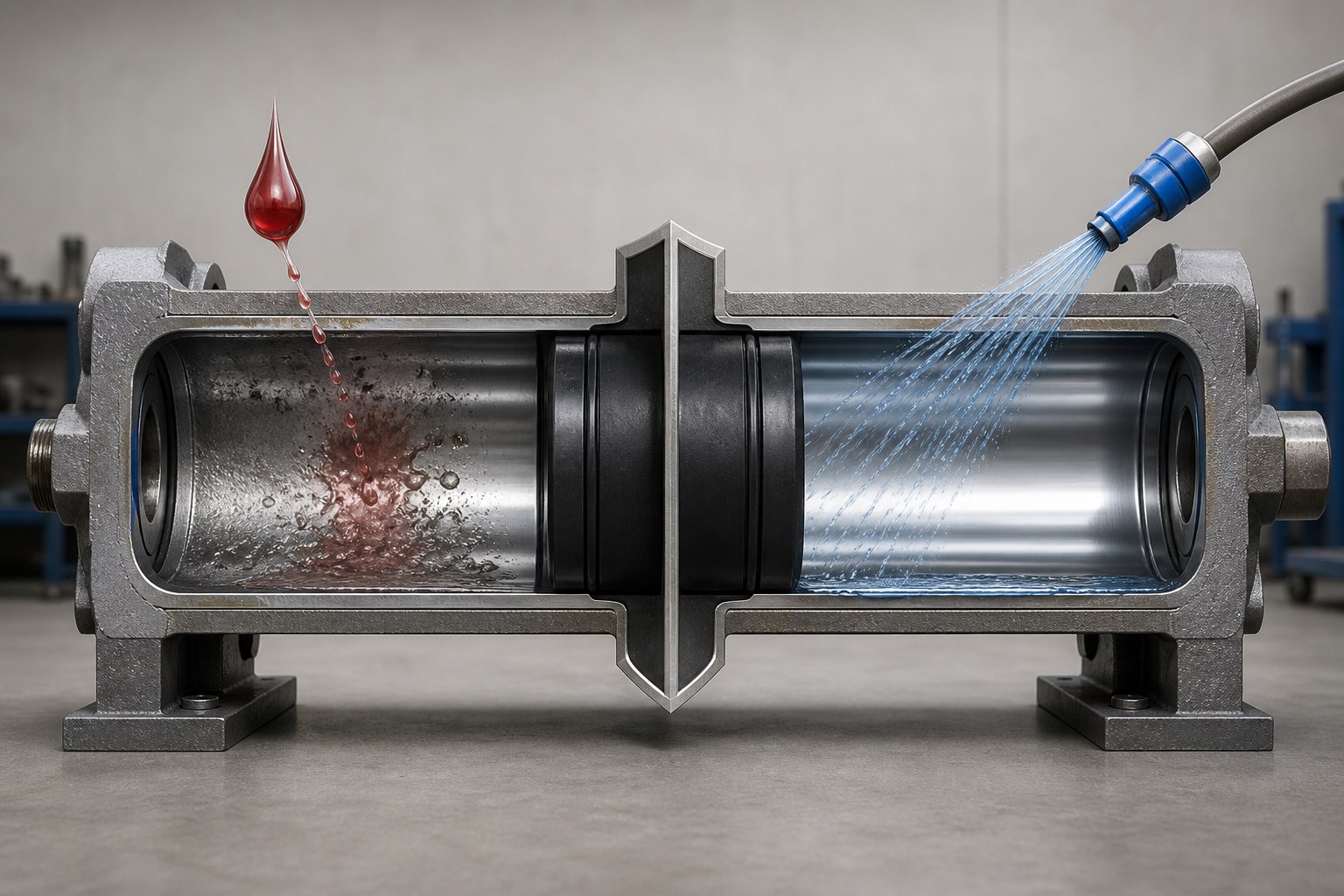
No: muriatic acid should not be circulated through or used to clean a concrete pump unless the pump manufacturer has issued a specific procedure authorizing that exact chemical for that exact surface. Multiple concrete-pump manuals warn that hydrochloric acid—commonly sold as muriatic acid—can damage the hard-chrome finish on material-cylinder bores. Aggressive cleaners may also attack rubber seals, exposed steel, plated rods, paint, and other components.
The temptation is understandable. Acid reacts with cementitious deposits, so it can appear to offer a quick solution when concrete has begun to harden. Inside a pump, however, removing the deposit is only half of the engineering problem. The cleaner must also be compatible with every wetted material, removable from crevices, safe for personnel, and managed under the applicable environmental rules. A product that cleans a concrete floor is not automatically suitable for a precision cylinder-and-piston interface.
Why an acid cleaner can create a cylinder problem
The working bore of many Concrete Pump Delivery Cylinders uses engineering hard chromium or another specified wear-resistant surface. Hard chrome is not decorative trim. It is part of the bore geometry and tribological system: the piston seal slides against it while abrasive concrete is drawn in and discharged under load.
Engineering chromium is selected for useful hardness, wear behavior, and friction characteristics. Its performance still depends on coating adhesion, thickness, finish, underlying steel, and the actual environment. NIST research on wear-resistant chromium coatings notes that wear behavior is influenced by more than hardness, including adhesion, internal stress, substrate deformation, and corrosion. The same work documented corrosion of steel through cracks in certain hard-chromium deposits.
Hydrochloric acid creates an acidic, chloride-rich environment. Depending on concentration, temperature, exposure time, contamination, and coating condition, it can destabilize the protective surface and reach defects or already worn areas. Once the substrate begins to corrode, the bore may develop pits, staining, underfilm attack, or local loss of adhesion. A rinse can remove liquid acid, but it cannot put dissolved metal back or restore the original surface geometry.
This is why OEM wording matters more than a generic claim that “chrome is corrosion resistant.” A Mayco operation manual states that muriatic acid must not be used because it can dissolve the chrome finish on the material-cylinder bore and main hydraulic-cylinder rods. Putzmeister service information likewise cautions against hard objects and caustic cleaning agents that could damage the delivery-cylinder chrome layer. Schwing documentation warns that many aggressive cleaners can harm chrome and rubber seals.
Dilution does not turn an unapproved chemical into an approved one
A common field argument is that heavily diluted acid, short contact time, or an immediate rinse makes the process safe. Those variables can reduce exposure, but they do not establish compatibility. The actual acid concentration may be unknown, deposits can trap liquid against the bore, and crevices can retain cleaner after the visible surface has been rinsed. Prior scoring or chrome loss can expose base metal directly.
Rubber compatibility also cannot be inferred from a brief visual check. A seal may swell, soften, harden, lose lip geometry, or suffer surface attack without failing immediately. Different pump models can use different elastomers and seal profiles. A chemical approved for one external painted surface may still be unsuitable for a delivery piston, shaft seal, wear-ring seal, hose, electrical connector, or plated rod.
Do not create a workshop dilution rule from advice about etching floors or cleaning masonry. Concrete floors are intentionally exposed mineral surfaces; a concrete pump contains precision moving interfaces. The substrates and acceptable consequences are completely different.
Which pump components deserve attention after acid exposure?
If muriatic acid or an unidentified aggressive cleaner entered the pump, treat the event as a system exposure rather than inspecting only the most visible stain.
| Area | Possible concern | Evidence to collect |
|---|---|---|
| Material-cylinder bore | Dulling, pitting, chrome loss, underfilm corrosion, increased roughness | Exposure boundary, photographs, bore map, coating and dimensional checks specified by the OEM |
| Delivery piston and seals | Chemical attack, loss of sealing contact, accelerated wear against a damaged bore | Lip condition, swelling or cracking, fragments, bypass evidence, part identification |
| Water box and piston rods | Acid carryover, corrosion of exposed steel or plated rods, contaminated water | Water condition, staining, rod surface, drainage path, affected seals |
| Transfer valve and wear interface | Attack on plated or finished surfaces and elastomeric seals | Cleaner path, dull patches, rust, seal condition, switching behavior |
| Hopper, fasteners, paint, wiring | Corrosion, coating lift, chemical trapped in joints or connectors | Run marks, discoloration, residue in seams, connector and harness condition |
If the cleaner reached an S-Valve Assembly or rock-valve mechanism, inspect the actual wetted path and seal materials for that design. Do not assume that only the delivery cylinders were exposed.
Symptoms that can appear after the event
Acid damage does not always produce an immediate dramatic failure. Early evidence may be a previously bright bore becoming matte, patchy, stained, or rough. Rust-colored marks near scores, pinholes, edges, or exposed steel deserve attention. A piston may begin wearing faster because its sliding surface has changed.
Operational symptoms can include increased material bypass, abnormal water-box contamination, repeated piston-seal damage, changing cylinder-filling efficiency, or declining output under otherwise comparable conditions. None of these observations proves acid damage by itself. Abrasive concrete, hardened residue, improper piston installation, misalignment, corrosion during storage, lubrication problems, and ordinary end-of-life wear can create overlapping symptoms.
The useful diagnostic chain is therefore: document the exposure, inspect the contact surfaces, measure where the manufacturer provides a method, compare both cylinders, and examine the piston system. Jumping directly from “low output” to “replace the cylinders” skips several possible causes.
What to do if acid has already entered the pump
First, stop introducing the chemical. Secure the machine using the manufacturer’s shutdown, lockout, stored-energy-release, and access procedures. Concrete pumps combine hydraulic pressure, accumulator energy, moving valve mechanisms, and pressurized material; chemical exposure does not remove those hazards.
Identify the product before deciding how to respond. Record the product name, safety data sheet, concentration, approximate quantity, contact time, temperature, application method, areas reached, and any rinsing already performed. “Concrete remover” is not a chemical identity. Products sold under that description can have very different formulations and compatibility limitations.
Follow the chemical manufacturer’s spill and first-aid instructions and the pump OEM’s cleaning guidance. Do not improvise a neutralization mixture inside the pump. Acid-base neutralization can generate heat and splashing, and an unsuitable neutralizer can introduce another residue or incompatibility. OSHA identifies hydrochloric acid as muriatic acid and lists a ceiling exposure limit; its hazards require workplace controls, not an informal rinse-and-smell test.
After the machine has been made safe and cleaned under an approved procedure, inspect before returning it to demanding service. If the exposure was significant or the bore appearance changed, a qualified repair facility or the equipment manufacturer should determine the required nondestructive, coating-thickness, surface-finish, and dimensional checks.
A practical post-exposure inspection plan
- Preserve the event record. Photograph chemical run paths and affected surfaces before evidence is removed. Mark orientation and cylinder side.
- Inspect the full bore. Use adequate lighting or an appropriate borescope after approved cleaning. Look for matte zones, discoloration, pits, flaking, raised edges, and longitudinal scoring.
- Map dimensions rather than taking one reading. Check the positions and directions specified by the OEM. A single diameter cannot describe taper, ovality, or localized attack.
- Evaluate the coating correctly. A coating-thickness gauge must be suitable for the coating/substrate system and used with the correct calibration and access. Do not invent a rejection limit from another pump model.
- Inspect piston components together. Record seal wear, damaged edges, looseness, swelling, cracking, and deposits. A new piston cannot repair a pitted or out-of-specification bore.
- Check other wetted materials. Include valve seals, chrome-plated rods, hoses, fittings, fasteners, paint, wiring, and drainage points reached by the cleaner.
- Use a controlled return-to-service test. Follow the manufacturer’s procedure and monitor the water box, leakage, switching, sound, and pumping behavior from protected positions.
Can the cylinder be honed or replated?
Possibly, but this is a dimensional engineering decision—not a cosmetic repair. Honing removes material and changes bore size and surface texture. Replating requires controlled stripping, substrate preparation, deposition, and final finishing. The finished bore must meet the required diameter, geometry, surface condition, coating adhesion, and compatibility with the piston system.
ASTM B177/B177M describes engineering chromium electroplating as a controlled process that includes substrate preparation, coating deposition, grinding or honing, and tests such as thickness, hardness, and adhesion. It is not evidence that every used concrete-pump cylinder is economically or technically repairable. Deep pitting, loss of base-metal geometry, cracking, distortion, or uncertain prior repair can make replacement the lower-risk choice.
Before requesting a repair or replacement quotation, provide the pump make, model, serial number, original part number, retained dimensional precision, bore measurements, overall and interface dimensions, photographs, piston information, and a description of the chemical event. Also state whether one or both cylinders were affected. This allows the supplier or repair shop to evaluate scope instead of guessing from a generic label such as “DN230 barrel.”
Preventing the problem
The most reliable control is to remove concrete before it hardens, using the cleaning sequence and tools specified by the equipment manufacturer. ACPA cleanout guidance emphasizes planning, trained personnel, controlled energy, and water as safer than compressed air where applicable. The exact procedure still depends on pump and pipeline design.
If a commercial concrete remover is being considered for an external surface, obtain written compatibility information for every material it may contact and confirm the pump manufacturer permits its use. Protect openings and internal components from overspray. Train operators to distinguish external cosmetic cleaning from internal pump cleaning, keep containers labeled, and make the approved products and procedure unambiguous.
Once concrete has hardened inside a delivery cylinder or valve system, stop and use the OEM service route. Aggressive scraping can damage chrome just as chemical attack can. The correct response may require controlled disassembly by trained personnel rather than a stronger chemical.
Conclusion
Muriatic acid may dissolve cementitious material, but that does not make it compatible with a concrete pump. OEM warnings, coating behavior, seal uncertainty, personnel exposure, and the difficulty of removing chemicals from crevices all point to the same decision: do not put an unapproved acid into the pump.
If exposure has already occurred, document the chemical and contact path, isolate the equipment safely, follow the SDS and OEM guidance, inspect the bore and piston as a working pair, and base repair or replacement on measured condition. Preventive washout remains far less destructive than trying to chemically rescue hardened concrete.
Technical references and further reading
- Mayco LS400/LS500 Operation and Parts Manual — warning against muriatic acid on material-cylinder bores and hydraulic rods.
- Putzmeister operation manual — cautions on delivery-cylinder cleaning and chrome-layer protection.
- Schwing operation manual for SP Rock Valve models — cleaning procedure and warning about aggressive cleaners around chrome and rubber seals.
- American Concrete Pumping Association cleanout safety bulletin — planning, training, and water-versus-air safety context.
- OSHA: Hydrogen Chloride — identification, exposure limits, and linked occupational-health resources.
- NIST: Electrodeposition of Wear Resistant Coatings — chromium-coating wear, cracking, substrate, and corrosion relationships.
- ASTM B177/B177M — scope of engineering chromium electroplating, finishing, repair, and test methods.